What DFIs are now requiring on board effectiveness
Development finance institutions - IFC, AfDB, EIB, FMO, Proparco, Norfund, DEG, BII - have quietly raised the bar on what they expect from African bank boards over the last 24 months. The shift is not in the headline ESG and impact requirements. It is in the board effectiveness assessment that now sits inside the standard equity or subordinated debt covenant pack.
From annual self-evaluation to external assessment
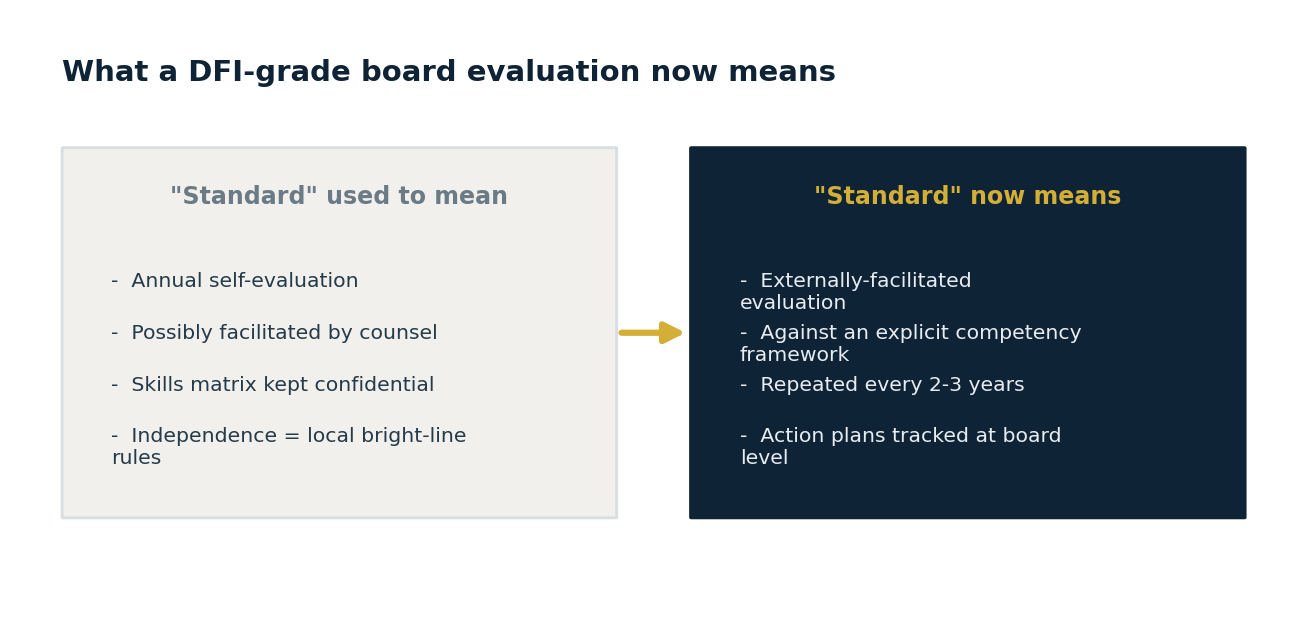
In 2026, no African Tier 2 bank can credibly close a DFI funding round without a board effectiveness exercise that meets contemporary global standards. "Standard" used to mean an annual self-evaluation, possibly facilitated by counsel. "Standard" now means an externally-facilitated board evaluation against an explicit competency framework, repeated every two to three years, with action plans tracked at the board level.
Three elements that are now non-negotiable
Three elements are now expected in due diligence, and they are not negotiable.
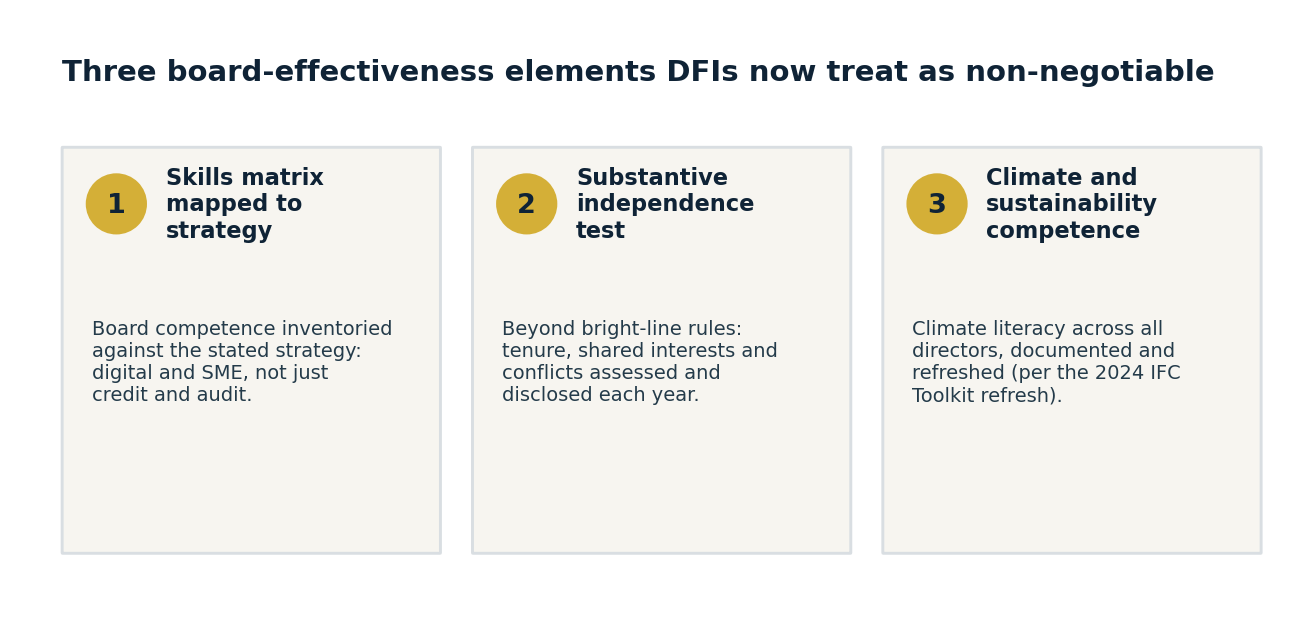
- Skills matrix mapped to strategy. The board's collective skills must be inventoried against the bank's stated strategy. If the strategy is to grow digital and SME, the board needs documented competence in those domains, not just in traditional credit and audit. DFIs increasingly ask to see the skills matrix during due diligence; "it's confidential to the nominations committee" is no longer an acceptable answer.
- Independence test that goes beyond bright-line rules. Many African bank boards meet local regulatory definitions of independence but have substantive independence gaps - long tenures, shared business interests, recurring conflicted transactions. The expectation is that the board explicitly assesses substantive independence each year and discloses material findings to the nominations committee and the lead independent director.
- Climate and sustainability competence at board level. This is the fastest-moving expectation. The 2024 IFC Board Effectiveness Toolkit refresh explicitly requires climate-related expertise in the board's collective skills. A bank with no director who can read a climate scenario output is now a finding. The fix is not necessarily a new director - a board climate-literacy programme delivered to all directors typically satisfies the requirement, but it must be documented and refreshed.
We have walked into DFI due-diligence rooms where a 60-page board pack was thrown back - because the skills matrix did not match the strategy and the independence test was a single-page checklist.
Where ARMA comes in
ARMA's board effectiveness engagement is an 8 to 10 week external evaluation that delivers a skills-matrix gap analysis, an independence substantive review, a climate-literacy curriculum, and a written board report your nominations committee chair can present - for African banks preparing for a DFI funding round or a senior leadership transition.