Working capital optimisation via supply chain finance [2021]
Originally published April 2021, republished here as part of ARMA's continuity record. The working capital pressures the original piece described in the COVID-era have settled into a permanent feature of African corporate balance sheets.
Supply chain finance (SCF) emerged from the 2008-09 global financial crisis as a working capital response to dislocated credit markets. African corporates discovered the same lesson during 2020-21: when bank lines tighten and DSO stretches, anchor-supplier financing becomes the most reliable way to keep the value chain liquid.
How the mechanics work
The mechanics are straightforward. An anchor corporate has confirmed payables to dozens or hundreds of upstream suppliers. A financier (bank or fintech) advances those payables at a discount keyed off the anchor's credit profile rather than the suppliers'. The suppliers get cash 30 to 90 days early. The financier earns the discount. The anchor improves working capital efficiency by extending DPO without damaging supplier liquidity.
Three features that make SCF powerful in Africa
For African corporates and African banks, three structural features make SCF particularly powerful as a working capital tool in 2026.
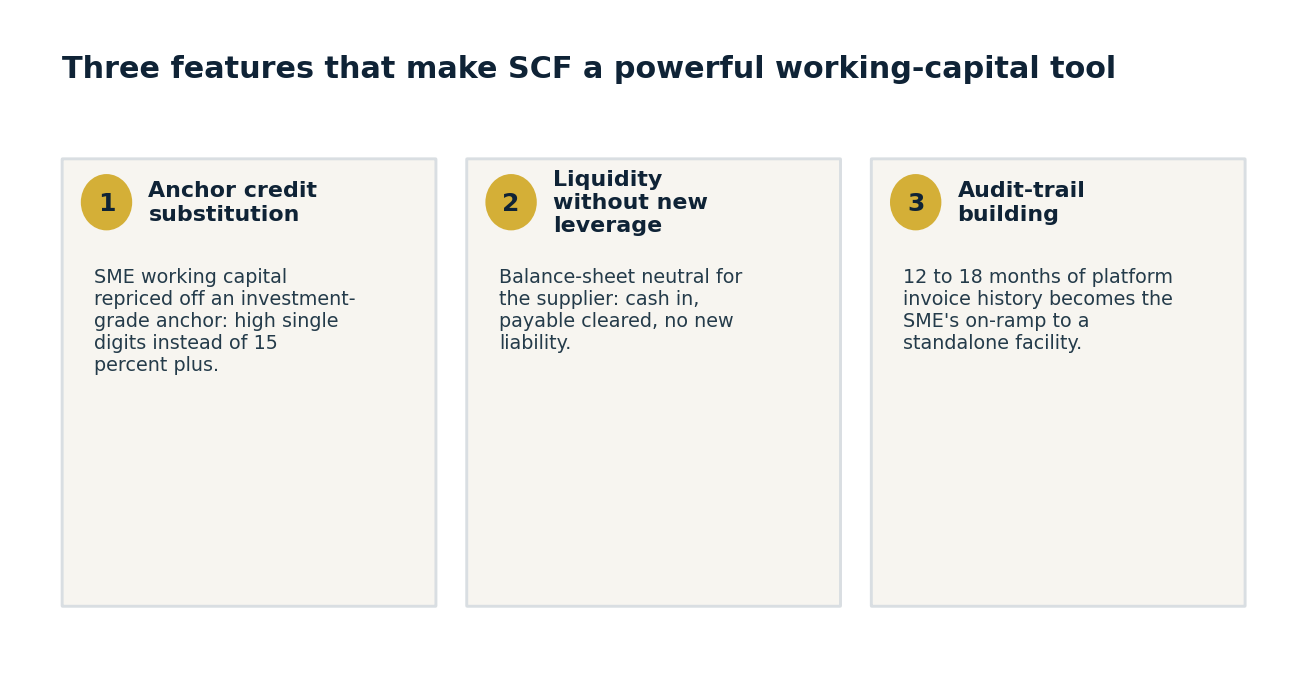
- Anchor credit substitution. Most African SMEs cannot raise standalone working capital at sub-15 percent APR. SCF priced off an investment-grade anchor's credit can land in the high single digits. For a supplier with a 10 percent net margin, that spread is the difference between a sustainable business and a survival exercise.
- Liquidity acceleration without leverage at supplier level. SCF is balance-sheet neutral for the supplier: cash in, payable cleared, no new liability. This is critically different from a bank loan and is the right product for thin-cap African SMEs that cannot carry more leverage.
- Audit-trail building. Each invoice that flows through an SCF platform creates verifiable transaction history. After 12 to 18 months on the platform, the supplier has documented cash-flow records that a Tier 2 bank's SME credit team will accept for a standalone working capital facility. The SCF programme becomes the financial-inclusion on-ramp.
What has held the model back
What has held the model back in Africa is not the financial logic. It is the orchestration cost. Onboarding 200 informal suppliers behind one anchor is operationally expensive at low ticket sizes, and most African banks have not built unit economics that make it work. The technology and orchestration layer required is now mature enough that the constraint has shifted to credit appetite and partnership design.
For a supplier with a 10 percent net margin, the spread between SCF pricing and standalone SME credit is the difference between a sustainable business and a survival exercise.
Where ARMA comes in
ARMA's SCF programme build engagement is a 10 to 14 week diagnostic and structuring exercise that delivers an anchor-suitability assessment, a supplier onboarding economic model, a credit policy and pricing framework, and a platform-vendor shortlist. It is built for African banks, anchor corporates with deep supplier networks, and DFIs structuring SCF facilities. Visit client.africarisk.net to scope the engagement.